the best thing abt cats is when ur letting them sniff ur hand to see if theyll let you pet them & they smush their face into ur hand in approval… makes me feel honored
“wouldn’t you rather earn something than have it just handed to you?”
Yeah when it comes to actual awards and fancy goods, but when it comes to basic needs, basic human decency, and accomodations, those things should always be handed to people. No one should have to “earn” those things.Value people as people, not base it on how much they produce.
yeah but that creates a severe dependency that could be exploited easily, and creates a slippery slope @musical-clarity
Actually studies show that people who live in places with universal income (who are given money with no strings attached just for being citizens) do far better work than those who don’t and are more enthusiastic to do work.
This is because they still want nice things and will work for those but the part of their energy that was devoted to worrying about if they have enough money to pay the rent and bills this month is now freed up to do other things.
Some people will always be lazy and take advantage of the system, but they are always a tiny percentage and it seems ridiculous to me to punish the majority and severly hamstring their abilities just because a handful of people will simply live of basic income rather than work.
It’s been tested a couple times. In Canada, in some European countries, and the results are always the same.
There are two groups of people who show a statistically significant (Greater than one half of one percent, or 1 in 200) increase in Not Working and living off the guaranteed income. Parents of Children under school age, and full time students.
Among ALL other groups, employment actually INCREASED. Why? Because guaranteed minimum income means that homeless people can get at least a basic low end apartment. It’s hard if not impossible to get an above board job without a permanent fixed address. Also more people were able to have and maintain a BANK ACCOUNT. It is often hard to get a decent job without an account that can accept Direct Deposit for paychecks.
Also, lost work time due to illness and injury decreased across the board. It turns out if people are getting a decent amount of money each month they can A> afford to eat better, and B> obtain decent medical attention both preventative and emergency. Crazy right?
So why hasn’t it caught on?
Because it doesn’t directly benefit the people in power, and it increases THEIR PERSONAL taxes, their CORPORATE TAXES, and thus decreases their PERSONAL INCOME.
So, because Jeff Bezos and Alan Greenspan might fall from making 100 billion dollars a year to making 99.8 billion dollars a year, it’s a hard NO and we can all fucking die..
The End.
The other reason the people in power hate it is because it fundamentally changes the relationship between employer and employee. In regular capitalism, the employer has all the power because if you quit you starve and if you get another job it’ll be equally shitty because all the bosses know that they have you by the gonads.
But with universal income, power is given to the workers. If your boss is an asshole, you can just quit without worrying about starving. So the employers are the ones that have to sell themselves and offer value for your time in order to keep enough staff to survive. And they HATE that.
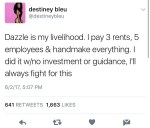
sooo khloe bought 1 of everything from this girl’s store and completely ripped off everything. badly. this designer has worked with people like beyoncé and serena williams, the klan has some fucking NERVE. and khloe has the balls the want to sue monica rose for stealing from her. the hypocrisy of it all
It is 100% professional to call out this sort of behaviour! If you need to spill to protect your livelihood, do it! It’s not just protecting yourself, but future people who might be screwed over in the same way.
I appreciate those people who are just genuinely nice. Like their mindset is instead of making others miserable, they give people tools to better themselves because why not. Thanks for putting that good energy out into the universe.
ok you know what I am officially sick of? – all these “inspirational” stories and anecdotes about disabled or chronically ill people still kicking ass and taking names.. like the one story that keeps going across my dash about the woman with breast cancer but she “didn’t let it stop her” .. well guess fucking what. It’s okay if a sickness stops you: sometimes it happens. It’s okay if you can’t get out of bed because of your illness: you’re still amazing. We don’t often hear enough about people whose superpower is surviving, but that’s what a lot of us have to do .. just focus on surviving. We take each day as it comes and sometimes, just taking a walk around the block is a big fucking deal. Don’t underestimate someone else’s struggle. Don’t expect a person to live up to anyone else’s ideals. Just stop. If someone needs to take a break, let them. If someone needs to cancel plans because of their illness or disability, let them. Stop giving them crap and comparing them to other people who have more spoons.
I think the problem with a lot of ostensibly “hardcore” video games is that both their fanbases and their developers think having a high skill floor is the same thing as having a high skill ceiling.
I’m not sure I understand. Do you mind explaining the difference?
In the jargon of game design, the “skill ceiling” is the point beyond which further improvements in player skill start to yield diminishing returns; there’s only so good you can get before it just stops making a difference, and that point varies from game to game. A game’s skill ceiling is said to be low when you can quickly explore everything it has to offer, and high when there’s ample room for long-term improvement.
The “skill floor”, conversely, is the minimum level of player skill that’s required to meaningfully participate in the game at all. All interactive media has to make certain assumptions about the player’s ability to engage with it, so in practice every game has a skill floor. A game’s skill floor is said to be low when the game is approachable enough that you can pick up the necessary skills as you go, and high when only prior experience with other, similar games will do.
As an illustrative example, consider Super Mario Odyssey. By most measures it has a fairly low skill floor; some prior experience with 3D platformers will certainly help you get into it, but just about anybody can muddle through and pick up a few power moons. On the flip side, Super Mario Odyssey’s skill ceiling is quite high; if you really know what you’re doing, you can complete the game in an hour flat – you can look up some speed-running videos on YouTube to see how that works in practice.
The problem with confusing the two is that a game having a high skill floor doesn’t necessarily guarantee that it has a correspondingly high skill ceiling. It’s entirely possible to design a game where once you’ve gotten over that initial steep learning curve, that’s all there is to it – there’s nothing more to be learned. A lot of games that cater to the “hardcore” crowd fall into this trap; they’re tough to get into, often to the point that they’re accessible only to folks with extensive prior experience with other games in the genre, but once you are in there’s just not all that much to them.