I discovered something useful today, taking breaks or exercising never helps me but THIS does, sharing to save a life
I just found out that some pro artists that work for companies like Dreamworks etc sometimes hold their pens this or similar way so it gotta work. Recently I spent 5 days on drawing for long periods of time (we talk about min 5 hours in one go to max 12 hours long crunch) and not once did my hand bother me.
Writing good romance is so difficult because the entire plot is based on character interactions and producing chemistry. The readers need to believe in the love, whether the hero and heroine have known one another for a week or for years. We need to believe.
So often I see ppl criticize the romance in books and it comes off as them hating romance and I’m like no no no no no, a well done romance is an exquisite piece of writing. It’s not romance in general that sucks, it’s bad romance that sucks. Insta love with no chemistry. Relationships with no conflict. Badly written heroes. Those romances suck.
But romance books? Written by masters of the genre? Those are amazing.
THIS RIGHT HERE
It’s easy to write bad romance, because good romance requires a near-doctorate level understanding of human psychology and motivations.
Here’s the thing… certain emotions are easy to evoke and others are very hard to master and write.
Anger. Hate. Rage. Fear. <– negative emotions are the easiest to write because they rely on primal instinct programmed into the human brain by thousands of years of evolution. Within cultures there are certain things that will always evoke rage (and this is why not all books translate well to other cultures). Certain fears are universal.
Every bestseller every written has a Universal Fear driving at least the opening act of the book if not the whole book itself. Most bestsellers use “I fear I am worthless.” or “I fear death.” as their driving focus. Everything from PRIDE AND PREJUDICE to HARRY POTTER has used this and it’s why it sells so well.
It’s also why Romance isn’t taken seriously at times.
Romance promises as a happy romantic ending. Which means the two most common universal fears are utterly erased by the genre requirements alone. No one is going to die. The characters are going to be loved and feel worthwhile by the end of the book.
Since readers are programmed by society to instinctively fear those things some people have trouble relating to a romance story where they must latch onto something other than fear to get through a book.
Joy. Humor. Laughter. Happiness. <— positive emotions are really hard to write because they are complex emotions. There is nothing that makes people universally happy. I know, it’s shocking. Not kittens. Not puppies. Not a mother’s love. That thing you love, adore, and can’t live without? Yeah, someone hates it.
This is why writing satire or humor is so difficult. It’s why happy books are dismissed as fluffy or silly. They have a much narrower audience. The author has to reach into the reader’s head and manipulate their emotions so that they can feel soaring triumph. There isn’t a shortcut to writing happiness.
LOVE. <– Such a complex thing. Little understood. Hard to define. Ever roving about. Love, especially sexual and romantic love, are so individual that there will never be a One Size Fits All.
When an author sets out to write a romance they have to convince the reader not only to abandon fear but they have to write humans who are complex, convincing, and through storytelling explain the psychology of these individuals so the reader goes, “Yes, yes! I see it! I see why these two are perfect together and could never be with anyone else!”
It’s at once something many people have an innate talent for (hello, shippers!) and that many people don’t understand. Understanding love requires a very unselfish, un-egocentric view of the world. You have to think like someone else. And then, as the author, you have to create a way for a reader to easily step into the mind of someone else and understand this attraction without using shortcuts like “I saw her and got a boner. It’s love!” Because that isn’t.
It’s easy to write bad romance. It’s easy to use shortcuts and script the book like a film. But where films can rely on music and facial expressions to convey the complexity of emotion a writer only has words. There is no soundtrack for Chapter 7. There is no set of words in the English language that properly express the depth of feeling, the longing and desire, of seeing someone you treasure turn and smile at someone else and knowing from the depths of your soul that you would give up everything just to keep them smiling.
Writing a good romance means balancing internal and external conflict, knowing a person’s weaknesses and strengths, and pairing them with someone(s) who fill in their gaps, boost their strengths, and make them happy at the same time. And then, after all of that, you have to find readers who will understand and appreciate the characters you’ve written. You have to make the reader fall in love too.
Done well Romance is the most complex literary form.
So there was a list going around tumblr for a while that made it to my dash of literary journals that accept open submissions (and will pay!), but upon inspection about half of them were closed indefinitely, and I found quite a few other places that looked interesting through further research, so I wanted to post my own list.
I tried to focus on things that paid professional grade (at least 6 cents per word), were friendly to speculative fiction, and specifically encouraged diversity and writing about marginalized groups.
(Please note that as of right now I have never submitted or been published with any of these, so if anyone has experience with them, good or bad, please feel free to message or reblog this with your experiences.)
Speculative Fiction
Strange Horizons— Speculative fiction (broadly defined) with an emphasis on diversity, unusual styles, and stories that address politics in nuanced ways. 8c per word. Up to 10,000 words, under 5,000 preferred. Responds within 40 days. LGBT+ positive.
Asimov’s Science Fiction— Primarily sci-fi but accepts fantasy and surreal fiction, but no high fantasy/sword and sorcery. Prefers writing that is character driven. 8-10c per word. 1,000-20,000 words. Responds in about five weeks.
Evil Girlfriend Media — Horror and urban fantasy centered on female empowerment and defying gender stereotypes. $100 flat payment. 4,000-7,000 words. No response times given. LGBT+ friendly.
Beneath Ceaseless Skies — Fantasy with a focus on secondary worlds and characters. 6c per word. Up to 10,000 words. Average response time 2-4 weeks.
Fantastic Stories— Speculative fiction with an emphasis on diversity and literary style. 15c per word. Up to 3,000 words. Responds within two weeks. LGBT+ positive.
Fiction Vortex— Serialized fantasy and speculative fiction. $300 for featured stories, $50 otherwise. 3,500 words or less. No response times given.
Shimmer— Speculative fiction with an emphasis on diversity, strong plots, vivid characters, and beautiful writing. 5c per word. 7,500 words or less (will consider longer words with query letter). Usually responds within two weeks. LGBT+ positive.
Clarkesworld Magazine— Sci-fi, fantasy, and other speculative fiction. 10c per word up to 5,000 words, 8c per word after. 1,000-16,000 words. Responds within days usually, gives a tracking number.
Apex Magazine— Speculative fiction of all kinds. 6c per word, +1c per word for podcast stories. Up to 7,500 words, all submissions over will be auto-rejected. Responds within 30 days.
Heliotrope Magazine— Speculative fiction of all kinds. 10c per word. Up to 5,000 words. Responds within 30 days.
Lightspeed Magazine— Speculative fiction of all kinds, with creativity and originality in terms of style and format encouraged. 8c per word. 1,500-10,000 words, under 5,000 preferred. LGBT+ positive. Submissions temporarily closed for their main magazine but is accepting for their People of Color Destroy Science Fiction special.
General Fiction
The Sun Magazine— General fiction, likes personal writing or writing of a cultural/political significance. $300-$1500 flat payment and a one year subscription to the magazine for fiction (also accepts essays and poetry). No minimum or maximum lengths but over 7,000 words discouraged. Responds in 3-6 months. Physical submissions only.
One Story— Any and all varieties of fiction, “unique and interesting” stories encouraged. $500 payment plus 25 contributor copies. 3,000-8,000 words. Usually responds in 2-3 months.
Camera Obscura— General fiction. $1000 for featured story, $50 for “Bridge the Gap” award, no payment for other contributors. 250-8,000 words. Response time vary, running just over two months as of now.
Flash Fiction
Daily Science Fiction— Speculative flash fiction (including sci-fi, fantasy, slipstream, etc.). 8c per word. Up to 1,500 words, but shorter stories given priority. Response times not listed.
Vestral Review — General flash fiction. 3-10c per word depending on length to a max of $25. Up to 500 words. Response within four months.
Flash Fiction Online— General flash fiction. $60 flat payment. 500-1,000 words. Response times not listed.
Novels/Novella
Riptide Publishing — Any LGBTQ manuscripts between 15,000 and 150,000 words. Currently especially interested in lesbian romances, trans stories, asexual/aromantic stories, romances with a happy ending, and genre fiction such as urban fantasy. Also has a YA branch. LGBT+ positive.
Crimson Romance — Romance stories of all kinds, currently seeking LGBT+ stories with a focus on emotional connections and relationships, especially m/m romance. Novel (55,000-90,000 words) or novella (20,000-50,000 words) length. LGBT+ positive.
Kindle Direct Publishing
Kindle Direct Publishing— Allows you to set your own prices, create your own cover art, and make royalties off of each sell. Any and all genres are welcome and if you’re prolific and smart about how you’re publishing you can make pretty good money.
For those of you that like everything neatly organised, here’s links to EVERY ONE of my first 150how to THINK when you draw TUTORIALS, in ALPHABETICAL ORDER for#SkillUpSunday!Enjoy, link, pin, share! Cheers!
A tool that I’ve found is really handy is a called the Cash Clock. It’s a simple program that measures both the time that you’re working on a piece as well as how much money you should be earning. You can adjust the hourly wage to whatever you feel is right. Simply start the clock whenever you begin working on a project right up until you’re finished. It can give you a clear indication of what you should charge for commissions.
No artist should make below minimum wage for their artwork.
PLEASE FOR THE LOVE OF GOD USE THIS INSTEAD OF CHARGING PEANUTS FOR YOUR BEAUTIFUL ARTWORK.
Please, please, please at least make sure you’re making minimum wage.
Please stop lowering the pay floor for independent artists everywhere by thinking $5-10/commission is anywhere close to an acceptable rate for something you spent three hours on.
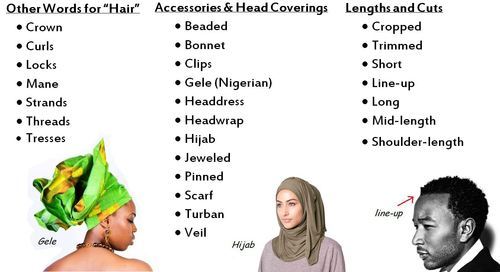
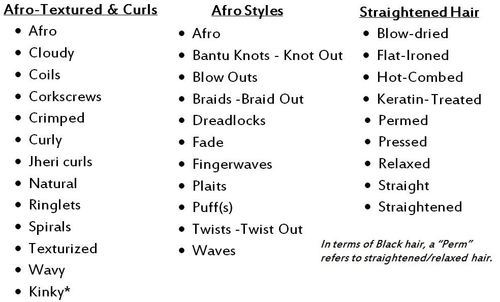
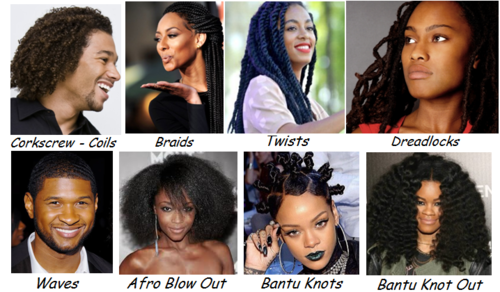
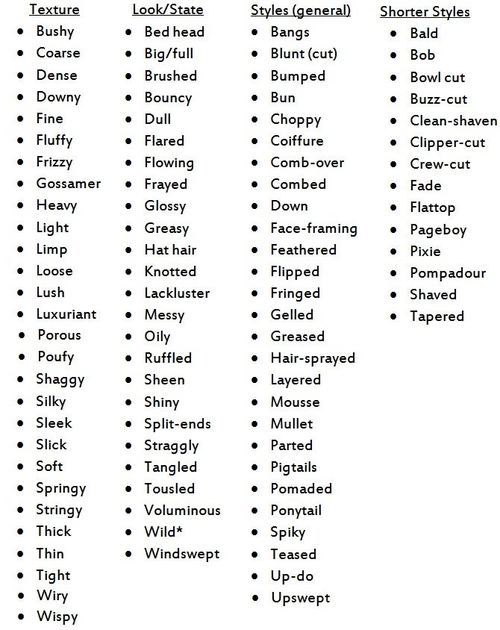
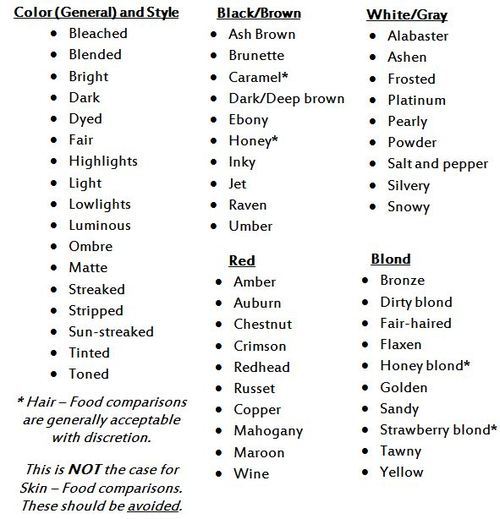
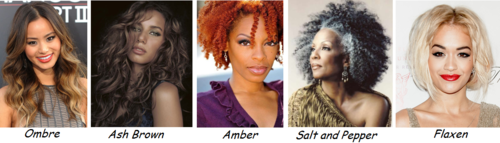
This began as a guide to describing Afro/curly hair but of course, I got carried away. From look and texture of hair, colors and various styles, this guide serves as a thesaurus of sorts for hair, as well as pointers for use in your writing.
Culturally Significant Hair Coverings:
Know the meaning behind head wear and why it’s worn, when and by whom, such as a Native Nation’s headdress, before bestowing a character with it.
Appropriative Hairstyles: Keep in mind that Afro styles should be kept to those in the African Diaspora, such as dreadlocks, cornrows + certain and many braided styles.
Tread carefully describing Afro hair as “wild” “unkempt” “untamed” or any words implying it’s unclean or requires controlling.
“Nappy” and “wooly” are generally words to stay away from, the first having heavy negative connotations for many and the latter, though used in the Holy Bible, is generally not acceptable anymore and comes off as dehumanizing due to Animal connotations.
There are mixed feelings on calling Black hair “kinky.” I’m personally not opposed to the word initself and usage depends on the person’s race (I’m more comfortable with a Black person using it vs. a Non-Black person) as well as their tone and context (if it’s used in a neutral or positive tone vs. negatively/with disdain). Get feedback on your usage, or simply forgo it.
Combination Words: Try combing words to illustrate look of hair. A character with springy coils that dance across her shoulders with every movement, the man with thick silvery hair slicked back into a ponytail…
Mind Perspective: Depending on POV, a character might not know exactly what cornrows or a coiffure style is, at least in name, and it might make more sense if they described the hairdo instead. More defining terms might come from a more knowing source or the wearer themselves. One book I read described a girl’s afro puff as “thick hair pulled up into a cute, curly, poufy thing on top of her head and tied with a yellow ribbon.”
POC & Hair Colors: People of Color’s hair comes in all shades and textures. There are Black people with naturally blond and loosely-textured to straight hair, East Asian people with red hair, and so on. Keep that in mind when coding characters if you tend to rely on hair color alone to denote a character is white vs. a Person of Color.
Related Tropes: There are tropes and discussion related to People of Color, colored hair, and light-colored hair and features.
if someone does the “fine, you’re right, i’m clearly a terrible person, i’m satan, i’m the worst person alive, i should just die” thing in response to criticism of their harmful behavior, they are trying to manipulate ppl and flip the situation around so that they look like a victim
stop tolerating this in 2k17 tbh. like really and truly, if you or your friend thinks this is okay pls call the hotline on the bottom of the screen and learn how to take responsibility for your bad behavior
The bad thing is I do this on a regular basis. Not because I want to manipulate people, but because that’s actually how I feel. I’m bad at receiving concrit. I can’t say that everyone who reacts this way feels the same as I do, but…not every case is like that.
have you considered that, regardless of your intentions, reacting in such an exaggerated way would make it very difficult for anyone to criticize you or tell you that you’re harming people with your behavior? i’m not interested in searching out people’s motives, i don’t really care why someone does or says manipulative things. being unable or unwilling to simply apologize and not make it about themselves is a solid indicator that a person is not interested in being held accountable for their bad behavior, and people, especially the injured parties in question, shouldn’t have to tolerate it.
take responsibility for your bad behavior 2k17 tbh
Okay, life lesson time.
When I was in my late teens and early 20s, I kept getting involved with people who would say, “Oh, I’m a bad person” any time I brought up ANYTHING that was the least bit of a disagreement.
Like, “Please don’t leave my X on the floor” would get, “Oh, I’m a horrible person!”
HERE’S WHY THIS IS A HUGELY PROBLEMATIC BEHAVIOR, and if you think I”m calling you out and you think you’re about to shut down, take a breath, remember that this is about learning, and keep reading.
What is important is what happened after. My boyfriend might say, “Oh, I’m just an awful boyfriend” and instead of him acknowledging the BEHAVIOR and working on fixing it, he’d get me trying to buck him up for the next half hour, telling him he was a good person. The behavior that started it all would not change.
Well, things led to things and I went back home to live for a while, and found that the same exact thing was happening… with my mother.
And then I learned about pattern arguments. Pattern arguments are the ones where you keep having the same nonproductive argument over and over again. They don’t all follow this pattern, but this is a really common one.
The trick?
BREAK THE PATTERN
First you have to know what the pattern is. In this case: 1. Grievance 2. Self deprecation 3. Ego stroking
So, with my mother, we started in on one of these, and she said, “I guess I’m just a terrible mother.”
And instead of reassuring her, instead of derailing the issue and letting it go… I said, “When you say that, it makes me wonder how terrible a daughter I could be that you would think you were a bad mother. We have this conversation this way over and over, and the problem that I have always gets pushed aside in favor of trying to make you feel better. When you’re willing to have a real conversation about this, I’m happy to talk to you, but I’m bored with this argument, so I’ll see you later if you want to really talk.” And I left the room.
Now, my mom is a reasonably self-aware person, and does a lot of hard emotional work, and so she got it, very quickly. 10 minutes later she came out and found me, and we had a real conversation about whatever the hell the issue really was, and we have literally NEVER had that particular pattern argument again in 23 years.
Boyfriend came to visit. I was upset about something, he started in on the “I’m just a shitty boyfriend” thing… and my response?
“Yep. You are.”
His jaw dropped. He blinked.
And I said, “Look, that’s what you do. You say shit like that and it means you don’t have to change your behavior, and I’m tired of the pattern we have where I tell you something isn’t working for me, you tell me you’re terrible, and I spend half an hour making you feel better. I’m tired of it and I”m not doing it anymore. If you’re willing to have an actual conversation about this, and not just the same old argument, I’m game. But this thing we do where you talk yourself down and I butter you up? Is boring. And I’m over it.”
We also did not have that argument again. (The relationship finally ended for real a while after, but it ended in a grown-up way, and not with a ridiculous meaningless fight.)
When you knock yourself down, the gut instinct for the people around you is to pick you up. But that means you’re not pulling your weight in the relationship. You’re making them do the work and you’re not actually hearing them.
So that brings us to another point:
How to deal with criticism
Okay, so if you’re not going to knock yourself down when someone says something negative about you, what DO you do? We don’t actually train people to take criticism well. But it is an art and a skill and NECESSARY to finding emotional stability in the face of a critical world.
I see it as a flow chart, but since the flow chart I made for it ended up in a book that I don’t own the copyright to (not a big deal) I’ll write out the decision tree here instead:
1. Someone offers criticism (constructive or not!)
2. Listen and think about it without immediately trying to defend yourself. You can say, “Okay, I need a moment to take that in and think about it because I want to understand it.” Or something else appropriate to the situation. It is okay to ask for time to think in most circumstances. Most people will appreciate that you are thinking about their words instead of immediately getting defensive or counterattacking. Think about whether what they are saying is valid, might be valid or is not valid.
3A. If it is valid, then you have a choice. You can try to fix the behavior or you can acknowledge that it is a valid criticism but decide you aren’t likely to fix it. Start by acknowledging the validity of the criticism, and then say what you’re going to do to fix it, or say that it’s valid but it isn’t something you’re willing (or possibly able) to change, or say that it’s a valid criticism and you’ll need to think about possible solutions. They may have a suggestion. Taking it or not is also a choice.
3B. If you’re not sure it’s valid, but it might be, tell them, “I really need to give this some more thought.” or “Can you tell me more about this? I’m not sure I understand the issue well.” Or “If you can point me at some reading material or search terms, I’d like to study this before I decide what I’m going to do.”
3C. If you know it is not a valid criticism, STOP a moment, and look at WHY they are making it. This is where Active Listening can be very helpful. “I hear you saying that X is a problem. I don’t see it that way right now but I’d like to understand better why you do.” Or if you think they don’t have enough information, “I hear you saying X, but my understanding of the issue is Y. Here’s what I know about it if you’re ready to listen.” If they’re just looking for a fight, tell them you’re not interested in fighting, and disentangle yourself.
4. If the criticism is something you are going to listen to and take action on, tell them what kind of action you’re going to take. If it’s something you’re hearing and thinking about, tell them that. If it’s not something you’re going to do anything about or it’s just wrong, thank them for their input and move on.
Literally never is it going to be helpful to say, “Oh, I’m just a terrible person.” That’s very much like a nonapology-apology in terms of how unhelpful it is to any conversation. It’s kind of worse because it actually expects emotional labor from someone who is already having to bring up something unpleasant with you.
Think about what they say Decide whether you’re going to do something about it Do the thing, or tell them you’re not going to do the thing. Don’t demand emotional labor from other people when you were the one who messed up.
Apologize if appropriate.
This is all predicated on the notion that you’re talking to someone who actually wants to communicate and isn’t just an asshole on the attack.
Because seriously, the whole “I’m a terrible person” thing?
Boring as fuck. Knock that shit off. Maybe you are. Maybe you aren’t. But take responsibility and have a little self-respect and don’t make others pick your emotional dirty towels off the metaphorical bathroom floor.


 Crowfanity's Tumblr