When you are writing a story and refer to a character by a physical trait, occupation, age, or any other attribute, rather than that character’s name, you are bringing the reader’s attention to that particular attribute. That can be used quite effectively to help your reader to focus on key details with just a few words. However, if the fact that the character is “the blond,” “the magician,” “the older woman,” etc. is not relevant to that moment in the story, this will only distract the reader from the purpose of the scene.
If your only reason for referring to a character this way is to avoid using his or her name or a pronoun too much, don’t do it. You’re fixing a problem that actually isn’t one. Just go ahead and use the name or pronoun again. It’ll be good.
Someone finally spelled out the REASON for using epithets, and the reasons NOT to.
In addition to that:
If the character you are referring to in such a way is THE VIEWPOINT CHARACTER, likewise, don’t do it. I.e. if you’re writing in third person but the narration is through their eyes, or what is also called “third person deep POV”. If the narration is filtered through the character’s perception, then a very external, impersonal description will be jarring. It’s the same, and just as bad, as writing “My bright blue eyes returned his gaze” in first person.
Furthermore,
if the story is actually told through the eyes of one particular viewpoint character even though it’s in the third person, and in their voice, as is very often the case, then you shouldn’t refer to the characters in ways that character wouldn’t.
In other words, if the third-person narrator is Harry Potter, when Dumbledore appears, it says “Dumbledore appears”, not “Albus appears”. Bucky Barnes would think of Steve Rogers as “Steve”, where another character might think of him as “Cap”. Chekov might think of Kirk as “the captain”, but Bones thinks of him as “Jim”.
Now, there are real situations where you, I, or anybody might think of another person as “the other man”, “the taller man”, or “the doctor”: usually when you don’t know their names, like when there are two tap-dancers and a ballerina in a routine and one of the men lifts the ballerina and then she reaches out and grabs the other man’s hand; or when there was a group of people talking at the hospital and they all worked there, but the doctor was the one who told them what to do. These are all perfectly natural and normal. Similarly, sometimes I think of my GP as “the doctor” even though I know her name, or one of my coworkers as “the taller man” even though I know his. But I definitely never think of my long-term life partner as “the green-eyed woman” or one of my best friends as “the taller person” or anything like that. It’s not a sensible adjective for your brain to choose in that situation – it’s too impersonal for someone you’re so intimately acquainted with. Also, even if someone was having a one night stand or a drunken hookup with a stranger, they probably wouldn’t think of that person as “the other man”: you only think of ‘other’ when you’re distinguishing two things and you don’t have to go to any special effort to distinguish your partner from yourself to yourself.
This is something that I pretty consistently have to advise for those I beta edit for. (It doesn’t help that I relied on epithets a lot in the earlier sections of my main fic because I was getting into the swing of things.) I am reblogging this so fanfic writers can use this as a reference.
A good rule of thumb: a character’s familiarity with another character decreases the need for an epithet (and most times you really don’t need one at all).
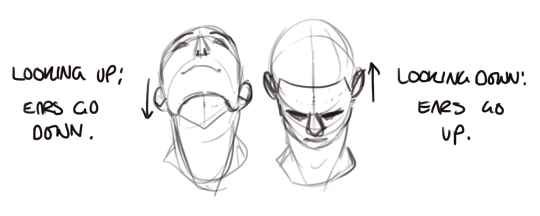
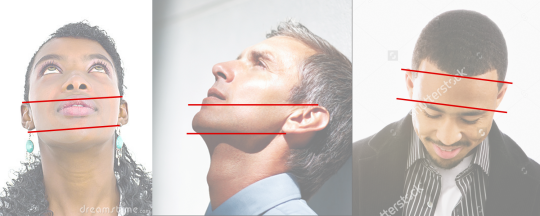
little art tip: the position of the ears on a human does a lot to communicate the angle of the head—whether it’s tilted forward or back.
tilted back with the chin forward, the ears are going to look lower down, closer to the mouth; tilted forward with the chin tucked, the ears look higher up & more in line with the eyes.
Sorry I’m not hijacking, but this is a really good tip if people don’t know this. Like it does look really strange at first, but it is more realistic than drawing them in the centre of the side plane of the head. So it looks like this;;;
You are allowed to grieve the years you lost to mental illness. You’re allowed to be mad that it happened to you. You’re allowed to pine after the person you might have been had it been different. But don’t let that get in the way of your growing into your new self and following a wholly new path for your life.
This is still something I struggle with, so this is less a tutorial and more just a collection of tips and things I’ve noticed when drawing clothing folds! I hope this helps some of you!
No one fucking knows what they’re doing, we’re all just faking it and pretending we understand so people will respect us but if you tell us we’re doing it wrong, you’re probably right because rarely does someone know better.
You will find something you like to do that you can make money doing.
You’re going to find friends that aren’t going to fucking wreck you.
You’re not always going to live in the hell hole that you’ve known for so long.
It’s going to get better, but I’ll be honest, it doesn’t always stay better, but it gets better again. Bad times are just times that are bad. They don’t stay. Everything is fucking temporary.
Just fucking watch your favorite TV shows, tell ppl you love them when you do, and don’t play games with emotions because it ends up hurting like hell.
And eat dessert when you want it.
And know you ALWAYS deserve better.
Reblogging because I had a long fucking day and need something nice to make me feel better
Don’t characterize a Black character as sassy or thuggish, especially when the character in question is can be described in literally ten thousand other ways..
Don’t describe Black characters as chocolate, coffee, or any sort of food item.
Don’t highlight the race of Black characters (ie, “the dark man” or “the brown woman”) if you don’t highlight the race of white characters.
Think very carefully about that antebellum slavery or Jim Crow AU fic as a backdrop for your romance.
If you’re not fluent with AAVE, don’t use it to try to look cool or edgy. You look corny as hell.
Don’t use Black characters as a prop for the non-Black characters you’re actually interested in.
Keep “unpopular opinions” about racism, Black Lives Matter, and other issues pertinent to Black folks out the mouths of Black characters. We know what the fuck you’re doing with that and need to stop.
Don’t assume a Black character likes or hates a certain food, music, or piece of pop culture.
Be extremely careful about insinuating that one or more of a Black character’s physical features are dirty, unclean, or ugly.
Feel free to add more.
Adding more…
Be wary of making Black characters seem animalistic, uncivilized, or subhuman in comparison to white characters. Watch out for: comparing us to monkeys, gorillas, chimpanzees, apes, and other animals.
Words like Negroid, colored/colured, Negro, and the n-word do not belong in the mouths of contemporary characters you want to portray as sympathetic.
Not all Black people are African American.
Africa is not a country but the second-largest continent on earth with some 54 different countries with thousands of ethnic groups and 1,500 to 3,000 languages and dialects.
Resist the urge to make a Black character seem uneducated and ignorant compared to white characters.
Capitalizing Black shows that you recognize that the word unifying people of African descent, particularly the diaspora, should be described using a proper noun.
Please, say “Black people,” not “blacks.”
Give Black characters the same psychological and moral complexity as white men are given by default.
Make sure that you don’t write a Black character as happily subservient to a white character.
Understand and show that you understand that Black characters don’t exist to be the caretakers of white characters.
And more…
Do your own homework instead of expecting, asking, or demanding Black fans to do it.
Before approaching that Black person you admire so much for being so articulate about race issues (this is sarcasm) to beta read your work: 1) make sure it’s something they’ve expressed interest in doing, and 2) you offer something in return for their time and expertise.
Be prepared for fans to have issues with what you came up with and open to suggestions.
Having only one Black character in a story that takes place in a huge city, country, or galaxy looks weird. Really, really weird. Scary weird.
Don’t use a Black character’s death to motivate a white character.
Portray Black characters with complex and multifaceted identities. We are more than just Black. We are also women, LGBT, Jewish, disabled, neurodivergent, immigrants, etc.
There is a huge chasm between hypersexual and desexualized.
Remember: what’s progressive for a white character is not necessarily progressive for a Black one.
These are some helpful pointers for writing any kind of fiction involving Black characters.

 Crowfanity's Tumblr