the All Around: speaks, reads, and writes both languages pretty well
the Conversational: one language is stronger than the other; can speak the other language a lot better than they read/write it (a lot of kids of immigrants are this type)
the High Schooler: understands what’s being said to them in the other language, can’t really speak it
don’t have your characters randomly drop words from their other language mid-sentence around people who don’t speak it lol
languages are a mindset thing. like personally if i’m around english-speakers, i’m speaking english and i don’t really switch to my other language (which is portuguese)
so like if you’re writing a bilingual character who speaks spanish and have them say something like “hey chad let’s go to the biblioteca” to an english speaker i’ll probably spend 5 minutes laughing and then close your story lmao
exception: the character is speaking in their weaker language and forgot a word (”where are the…? uh… llaves…. keys! keys, where are they?”)
otherwise really the only time your character should be randomly switching languages mid-sentence is if they’re talking to another bilingual
like i don’t speak spanish but i’ve legit never heard a spanish speaker say “ay dios mio” to gringos lmao
conversations between two bilingual people can take a few different forms:
Pick One: they pick one language and kinda stick with it for the whole conversation (a conversation i might have with my portuguese-speaking mom: ”you okay?” “yeah, i’m good. how’re you?” “i’m fine, but your dad-”)
Back-and-Forth: someone says something in one language, the other person replies in the other (”tudo bem?” “yeah, i’m good. how’re you?” “tou bem, mas o seu pai-”)
Combo: they speak a combo of the two languages, a popular example being spanglish, though basically every bilingual has their own combo language (”tudo bem?” “sim, tou bem. how’re you?” “i’m fine, mas o seu pai-”)
when in doubt: just ask a bilingual to look at your stuff and tell you if anything sounds weird
combo languages can look different depending on the bilingual
me and my cousin (native english speakers) speaking our portuguese/english combo sounds a lot different than my mom and my godmother (native portguese speakers) doing the same thing
the kids of immigrants usually come up with their own unique way of saying things that are different than native speakers
if you’re writing a bilingual family the older kids’ll probably be more bilingual than the younger ones
also, to clarify: bilingual characters might say words in another language on purpose in front of non-speakers
either to fuck with them or just ‘cause the word captures what they’re feeling more (i use “caralho” a lot)– basically the point is that accidental switching is relatively uncommon
i know earlier i said that people will forget words if they’re speaking their weaker language but tbh i do it with my stronger language too so really it works both ways
filler words are weirdly universal
so like while bilingual people don’t usually switch languages around people who aren’t bilingual we’ll throw filler words in
“ele me olhou e, like, eu juro que eu quase deu um soco nele-”
a lot of languages borrow words from english so it’s not too weird to have a random english word in an otherwise non-english conversation (my aunt @ my mom: “lilian você viu meu post no Facebook?”)
also sounds in general are just kind of a language transcending thing
you wanna find out what someone’s first language was?? break one of their bones lol
legit me when i cracked my rib: “AIIIIIII JESUS CHRIST TAKE ME TO THE HOSPITAL”
so if your character gets hurt they might make a sound of pain associated with their native language but will probably still speak in the language of the people they’re surrounded by. probably. it depends on just how much pain they’re in
if two people start speaking another language in public there’s a 40% chance they’re talking shit and a 60% chance they’re having a conversation like: “where’s the bathroom” “i don’t know, ask the waitress she’s right here” “i can’t just ask-”
this is the most accurate bi/multilingual reference post on here y’all should take notes 👀
Vulgar is a conlang (constructed/fictional language) generator created to help literally generate a language for you. No, really. No tricks, and it’s super simple to use. It’s my favourite tool right now for writing fantasy, even as someone who loves creating his own languages, it’s an amazing starting point.
Want a random conlang, straight away, with no prep or fuss? Just visit http://vulgarlang.com/index.html and click “Generate New Conlang”… and that’s it. Scroll down and through your brand new, generated, completely original conlang.
If you’re a little more advanced in terms of conlanging and want to specify IP phonemes to be used, you can add them too, but even with no knowledge of linguistics you can create a language at the click of your fingers.
This version of Vulgar is completely free, sure…. but! the guy who created it has not only made an amazing thing (which I repeat, is absolutely free at it’s most basic point), but is also planning on updating it more and more!
Under the “Buy” tab on the Vulgar website, he links to his email, where you can offer to pay for the full version of Vulgar, which is a total steal right now at a sale price of only nineteen dollars. Considering professional conlangers and linguists could charge you, like, a metric fuck ton of money for the same data you’re getting here for just nineteen, that’s a major steal.
Not to mention, buying the alpha build now gives you free access to all of it’s updated versions, which I can guarantee are just going to get better and better! I’ve already bought it and I adore it, and this is a tool the likes of which we in the conlang community have never seen in such an awesome way.
Please consider helping Vulgar out, because the creator is a damn genius
When writing or reading emotions, it’s much more evocative to be able to name where in the body emotions are felt and how, and for this, I use this chart by Lauri Nummenmaa (source)!!!! The differences between some emotions (e.g. fear and anxiety) may be small, but it’s those key differences that can change the tide and tone of a scene!
I just did a quick perusal of the Coptic resources on this site, and it has all the resources I’ve personally found worthwhile and then some. These are resources that took me months, if not years, to discover and compile. I am thoroughly impressed. The other languages featured on the site are:
Akkadian
Arabic
Aramaic
Church Slavonic
Egyptian (hieroglyphics and Demotic)
Elamite
Ethiopic (Ge’ez)
Etruscan
Gaulish
Georgian
Gothic
Greek
Hebrew
Hittite
Latin
Mayan (various related languages/dialects)
Old Chinese
Old English
Old French
Old Frisian
Old High German
Old Irish
Old Norse
Old Persian
Old Turkic
Sanskrit
Sumerian
Syriac
Ugaritic
For the love of all the gods, if you ever wanted to learn any of these languages, use this site.
Likely helpful for various recon-oriented polytheists.
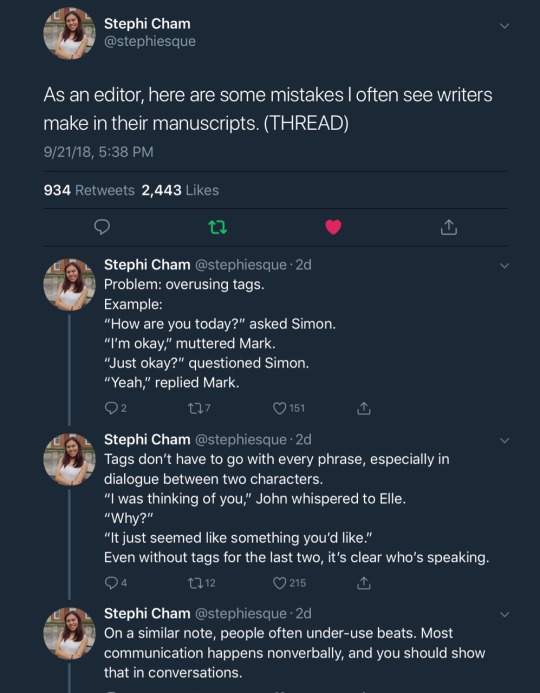
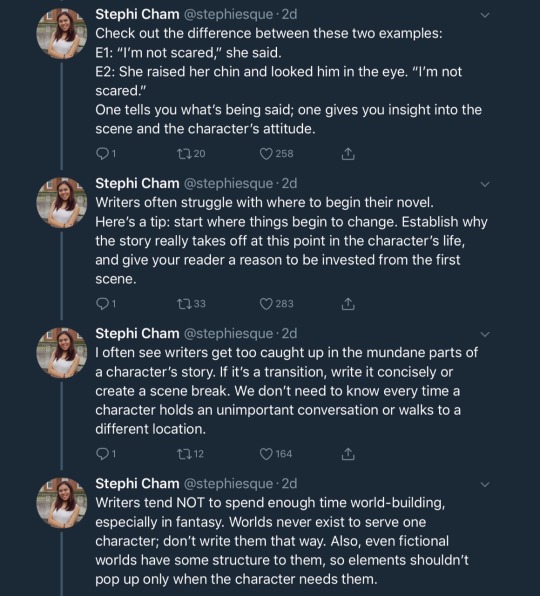
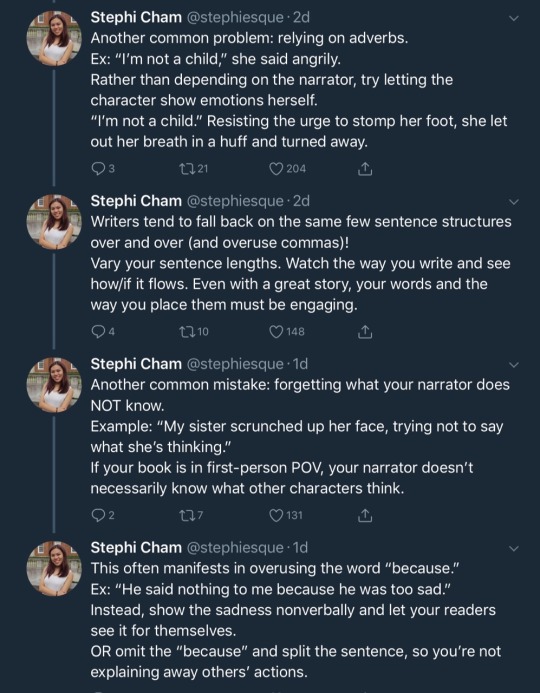
This. This is good fiction writing advice. I really appreciate how it was formatted as “this is a common problem, here is a solution to try in your own work” and not “oh god, don’t do that!” without any extra help. And I extra appreciated the “don’t rely on adverbs” bit, because they do have their place but they aren’t the only way actions can be emphasized.
a writing advice post: don’t describe characters’ eye colors, people don’t usually notice that in real life
me: anyway this character has pale blue eyes and this one has brownish-black and this one has sea green and you’re not my mother, you can’t make me stop
The trick is actually when you describe eye colours.
If a character is standing a good distance away from the character describing them, then unless they have massive and/or unusually vivid eyes (in which case, carry on) then no, they’re eye colour isn’t gonna be what jumps out about them.
So save it for later.
It can actually be a really moving experience to notice something pretty about another person’s eyes, the first time you’re close enough to. One of the major downsides of the ‘list format’ of description, where you just dump stuff like hair colour, eye colour, skin tone, height, built, etc in one big block, is that you lose a lot of the little human moments where people are honestly liable to pick up details about one another.
If you just tell me that, say, a character’s eyes have flecks of green in them, that’s boring. If your POV character notices the flecks of green in someone’s eyes because they’re sitting together on a couch and laughing and the light hit them just right and oh, so-and-so actually has unfairly pretty hazel eyes?
That’s a Moment™.
Pretty much yeah. You’ve got to save description. Don’t just dump everything into a paragraph. Have the character suddenly realize ‘wow you’re tall’. Have someone realize that another character’s brown hair has red and gold highlights in the sunlight.
Description is like salt. It makes things flavorful, but if you dump it all in once place, it’s not so hot.

 Crowfanity's Tumblr