‘Always show, not tell,’ is a big fat lie. If you always show, you’ll have half a novel of descriptive words and flowy sentences that will be hard to read.
Here is a quick tip:
Show emotion.
Tell feelings.
Don’t tell us ‘she was sad.’ Show us- ‘Her lip trembled, and her eyes burned as she tried to keep her tears at bay.’
Don’t show us ‘her eyelids were heavy- too heavy. Her limbs could barely function and she couldn’t stop yawning.’ Tell us – ‘she felt tired that morning.’
Showing emotion will bring the reader closer to the characters, to understand their reactions better. But I don’t need to read about how slow she was moving due to tiredness.
Likewise, when you do show, keep it to a max three sentences. Two paragraphs of ‘how she was sad,’ with no dialogue or inner thought is just as boring.
It can be hard to remember how to properly address your noble or royal characters when writing a fantasy court. Here is a quick guide:
1. King/Queen:
Usually addressed as either “Your Grace” or “Your Majesty”. Consort (married to a ruler and not reigning in their own right) can be addressed the same. Sire or Madam can be used also.
2. Prince/Princess:
They are addressed as “Your Highness”. They are NEVER addressed the same as a King or Queen
3. Duke/Duchess:
These are addressed with “Your Grace”. This was a common term also used by royalty before Henry VIII got to big for his codpiece.
4. Earl (Count)/Countess:
Are almost never referred as the “Earl of Narnia” but “Lord Narnia”.
5. Lord/Lady:
An easy one. They are called “My Lord” or “My Lady”.
6. Emperor/Empress:
These may be equal to a King/Queen for status but the have a grander title. They are only addressed as “Your Imperial Highness/Majesty”
I hope this helps when writing your court or fantasy novel.
Unreliable narrators need to add something to the story. They aren’t an excuse for poor storytelling and inconsistencies.
If you have an unreliable narrator, you should be doing twice as much work in your plotting! At every turn of the story, you need to know both what’s actually happening AND what your narrator thinks is happening.
When you’re right, you’re right. And you’re right.
Not only does the author need to know what’s happening on both layers of story, they need to actually write in clues for the reader to telegraph the lower, “true,” layer of the story so the reader is capable of figuring it out if they choose to read closely. Without that double work, an unreliable narrator cannot perform its literary function.
It is the evidence of the truth, not the lie the narrator tells, that makes a narrator unreliable. Otherwise they are just a liar which the audience is incapable of catching due to the hobbling imposed by the medium. Which means the lie may as well be the truth, making it serve no function as a lie.
Writing good romance is so difficult because the entire plot is based on character interactions and producing chemistry. The readers need to believe in the love, whether the hero and heroine have known one another for a week or for years. We need to believe.
So often I see ppl criticize the romance in books and it comes off as them hating romance and I’m like no no no no no, a well done romance is an exquisite piece of writing. It’s not romance in general that sucks, it’s bad romance that sucks. Insta love with no chemistry. Relationships with no conflict. Badly written heroes. Those romances suck.
But romance books? Written by masters of the genre? Those are amazing.
THIS RIGHT HERE
It’s easy to write bad romance, because good romance requires a near-doctorate level understanding of human psychology and motivations.
Here’s the thing… certain emotions are easy to evoke and others are very hard to master and write.
Anger. Hate. Rage. Fear. <– negative emotions are the easiest to write because they rely on primal instinct programmed into the human brain by thousands of years of evolution. Within cultures there are certain things that will always evoke rage (and this is why not all books translate well to other cultures). Certain fears are universal.
Every bestseller every written has a Universal Fear driving at least the opening act of the book if not the whole book itself. Most bestsellers use “I fear I am worthless.” or “I fear death.” as their driving focus. Everything from PRIDE AND PREJUDICE to HARRY POTTER has used this and it’s why it sells so well.
It’s also why Romance isn’t taken seriously at times.
Romance promises as a happy romantic ending. Which means the two most common universal fears are utterly erased by the genre requirements alone. No one is going to die. The characters are going to be loved and feel worthwhile by the end of the book.
Since readers are programmed by society to instinctively fear those things some people have trouble relating to a romance story where they must latch onto something other than fear to get through a book.
Joy. Humor. Laughter. Happiness. <— positive emotions are really hard to write because they are complex emotions. There is nothing that makes people universally happy. I know, it’s shocking. Not kittens. Not puppies. Not a mother’s love. That thing you love, adore, and can’t live without? Yeah, someone hates it.
This is why writing satire or humor is so difficult. It’s why happy books are dismissed as fluffy or silly. They have a much narrower audience. The author has to reach into the reader’s head and manipulate their emotions so that they can feel soaring triumph. There isn’t a shortcut to writing happiness.
LOVE. <– Such a complex thing. Little understood. Hard to define. Ever roving about. Love, especially sexual and romantic love, are so individual that there will never be a One Size Fits All.
When an author sets out to write a romance they have to convince the reader not only to abandon fear but they have to write humans who are complex, convincing, and through storytelling explain the psychology of these individuals so the reader goes, “Yes, yes! I see it! I see why these two are perfect together and could never be with anyone else!”
It’s at once something many people have an innate talent for (hello, shippers!) and that many people don’t understand. Understanding love requires a very unselfish, un-egocentric view of the world. You have to think like someone else. And then, as the author, you have to create a way for a reader to easily step into the mind of someone else and understand this attraction without using shortcuts like “I saw her and got a boner. It’s love!” Because that isn’t.
It’s easy to write bad romance. It’s easy to use shortcuts and script the book like a film. But where films can rely on music and facial expressions to convey the complexity of emotion a writer only has words. There is no soundtrack for Chapter 7. There is no set of words in the English language that properly express the depth of feeling, the longing and desire, of seeing someone you treasure turn and smile at someone else and knowing from the depths of your soul that you would give up everything just to keep them smiling.
Writing a good romance means balancing internal and external conflict, knowing a person’s weaknesses and strengths, and pairing them with someone(s) who fill in their gaps, boost their strengths, and make them happy at the same time. And then, after all of that, you have to find readers who will understand and appreciate the characters you’ve written. You have to make the reader fall in love too.
Done well Romance is the most complex literary form.
So there was a list going around tumblr for a while that made it to my dash of literary journals that accept open submissions (and will pay!), but upon inspection about half of them were closed indefinitely, and I found quite a few other places that looked interesting through further research, so I wanted to post my own list.
I tried to focus on things that paid professional grade (at least 6 cents per word), were friendly to speculative fiction, and specifically encouraged diversity and writing about marginalized groups.
(Please note that as of right now I have never submitted or been published with any of these, so if anyone has experience with them, good or bad, please feel free to message or reblog this with your experiences.)
Speculative Fiction
Strange Horizons— Speculative fiction (broadly defined) with an emphasis on diversity, unusual styles, and stories that address politics in nuanced ways. 8c per word. Up to 10,000 words, under 5,000 preferred. Responds within 40 days. LGBT+ positive.
Asimov’s Science Fiction— Primarily sci-fi but accepts fantasy and surreal fiction, but no high fantasy/sword and sorcery. Prefers writing that is character driven. 8-10c per word. 1,000-20,000 words. Responds in about five weeks.
Evil Girlfriend Media — Horror and urban fantasy centered on female empowerment and defying gender stereotypes. $100 flat payment. 4,000-7,000 words. No response times given. LGBT+ friendly.
Beneath Ceaseless Skies — Fantasy with a focus on secondary worlds and characters. 6c per word. Up to 10,000 words. Average response time 2-4 weeks.
Fantastic Stories— Speculative fiction with an emphasis on diversity and literary style. 15c per word. Up to 3,000 words. Responds within two weeks. LGBT+ positive.
Fiction Vortex— Serialized fantasy and speculative fiction. $300 for featured stories, $50 otherwise. 3,500 words or less. No response times given.
Shimmer— Speculative fiction with an emphasis on diversity, strong plots, vivid characters, and beautiful writing. 5c per word. 7,500 words or less (will consider longer words with query letter). Usually responds within two weeks. LGBT+ positive.
Clarkesworld Magazine— Sci-fi, fantasy, and other speculative fiction. 10c per word up to 5,000 words, 8c per word after. 1,000-16,000 words. Responds within days usually, gives a tracking number.
Apex Magazine— Speculative fiction of all kinds. 6c per word, +1c per word for podcast stories. Up to 7,500 words, all submissions over will be auto-rejected. Responds within 30 days.
Heliotrope Magazine— Speculative fiction of all kinds. 10c per word. Up to 5,000 words. Responds within 30 days.
Lightspeed Magazine— Speculative fiction of all kinds, with creativity and originality in terms of style and format encouraged. 8c per word. 1,500-10,000 words, under 5,000 preferred. LGBT+ positive. Submissions temporarily closed for their main magazine but is accepting for their People of Color Destroy Science Fiction special.
General Fiction
The Sun Magazine— General fiction, likes personal writing or writing of a cultural/political significance. $300-$1500 flat payment and a one year subscription to the magazine for fiction (also accepts essays and poetry). No minimum or maximum lengths but over 7,000 words discouraged. Responds in 3-6 months. Physical submissions only.
One Story— Any and all varieties of fiction, “unique and interesting” stories encouraged. $500 payment plus 25 contributor copies. 3,000-8,000 words. Usually responds in 2-3 months.
Camera Obscura— General fiction. $1000 for featured story, $50 for “Bridge the Gap” award, no payment for other contributors. 250-8,000 words. Response time vary, running just over two months as of now.
Flash Fiction
Daily Science Fiction— Speculative flash fiction (including sci-fi, fantasy, slipstream, etc.). 8c per word. Up to 1,500 words, but shorter stories given priority. Response times not listed.
Vestral Review — General flash fiction. 3-10c per word depending on length to a max of $25. Up to 500 words. Response within four months.
Flash Fiction Online— General flash fiction. $60 flat payment. 500-1,000 words. Response times not listed.
Novels/Novella
Riptide Publishing — Any LGBTQ manuscripts between 15,000 and 150,000 words. Currently especially interested in lesbian romances, trans stories, asexual/aromantic stories, romances with a happy ending, and genre fiction such as urban fantasy. Also has a YA branch. LGBT+ positive.
Crimson Romance — Romance stories of all kinds, currently seeking LGBT+ stories with a focus on emotional connections and relationships, especially m/m romance. Novel (55,000-90,000 words) or novella (20,000-50,000 words) length. LGBT+ positive.
Kindle Direct Publishing
Kindle Direct Publishing— Allows you to set your own prices, create your own cover art, and make royalties off of each sell. Any and all genres are welcome and if you’re prolific and smart about how you’re publishing you can make pretty good money.
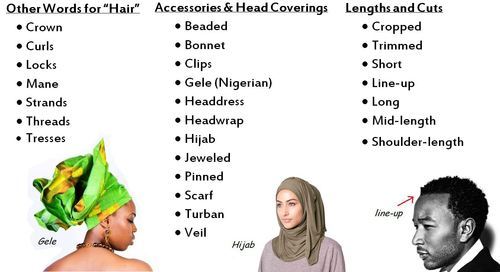
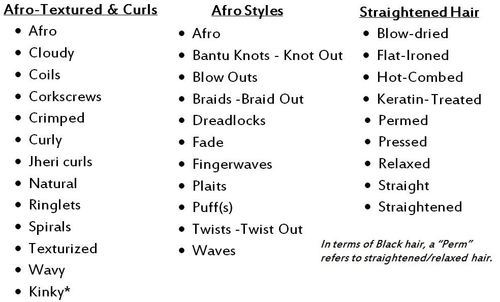
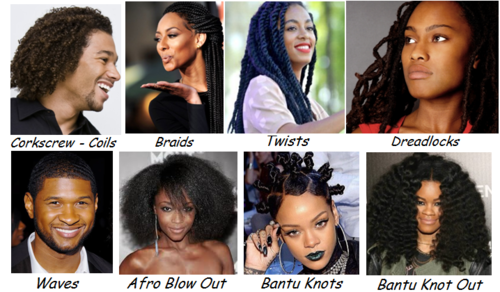
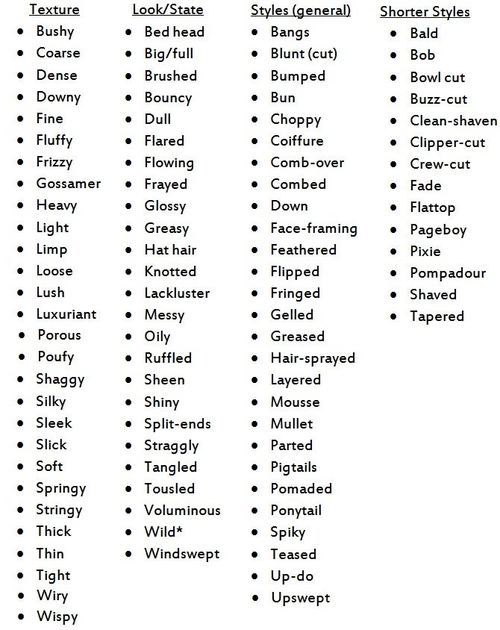
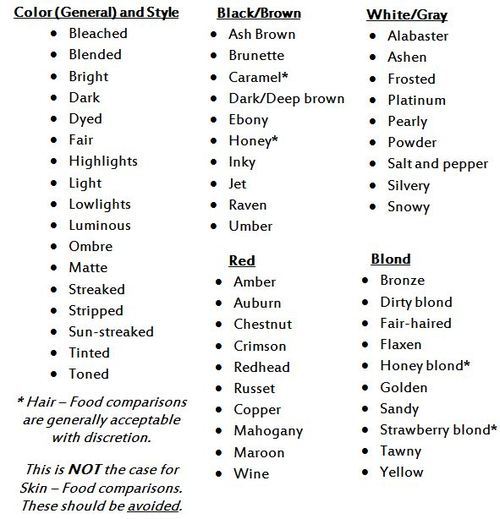
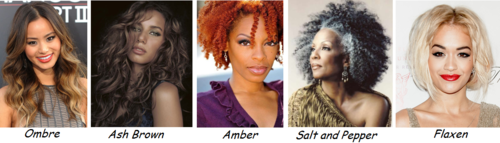
This began as a guide to describing Afro/curly hair but of course, I got carried away. From look and texture of hair, colors and various styles, this guide serves as a thesaurus of sorts for hair, as well as pointers for use in your writing.
Culturally Significant Hair Coverings:
Know the meaning behind head wear and why it’s worn, when and by whom, such as a Native Nation’s headdress, before bestowing a character with it.
Appropriative Hairstyles: Keep in mind that Afro styles should be kept to those in the African Diaspora, such as dreadlocks, cornrows + certain and many braided styles.
Tread carefully describing Afro hair as “wild” “unkempt” “untamed” or any words implying it’s unclean or requires controlling.
“Nappy” and “wooly” are generally words to stay away from, the first having heavy negative connotations for many and the latter, though used in the Holy Bible, is generally not acceptable anymore and comes off as dehumanizing due to Animal connotations.
There are mixed feelings on calling Black hair “kinky.” I’m personally not opposed to the word initself and usage depends on the person’s race (I’m more comfortable with a Black person using it vs. a Non-Black person) as well as their tone and context (if it’s used in a neutral or positive tone vs. negatively/with disdain). Get feedback on your usage, or simply forgo it.
Combination Words: Try combing words to illustrate look of hair. A character with springy coils that dance across her shoulders with every movement, the man with thick silvery hair slicked back into a ponytail…
Mind Perspective: Depending on POV, a character might not know exactly what cornrows or a coiffure style is, at least in name, and it might make more sense if they described the hairdo instead. More defining terms might come from a more knowing source or the wearer themselves. One book I read described a girl’s afro puff as “thick hair pulled up into a cute, curly, poufy thing on top of her head and tied with a yellow ribbon.”
POC & Hair Colors: People of Color’s hair comes in all shades and textures. There are Black people with naturally blond and loosely-textured to straight hair, East Asian people with red hair, and so on. Keep that in mind when coding characters if you tend to rely on hair color alone to denote a character is white vs. a Person of Color.
Related Tropes: There are tropes and discussion related to People of Color, colored hair, and light-colored hair and features.
A quick little something I knocked together, the patented tragic backstory generator ™ is the easiest way to give your character a mythically horrible origin.
(actual tragedy may vary, results are final and non-negotiable, i am not responsible for any tears you may shed while imagining the sad life your character must have led up to this point)
I literally only have one rule in my writing and it is this:
No matter what I put my characters through, they make it. They get to make it to the end of the story and have everything work out and be ok.
Because that’s the story I need. So it’s the kind I write.
If you want a piece of writing advice: write a story that is what you needed to hear at whatever age your target demographic is. I can guarantee you there’ll be someone out there who needs to hear it as much as you did. And maybe you’ll help them the same way someone else’s story did for you.
For some reason, this hit home and I never realized it that I did this for my stories too




 Crowfanity's Tumblr