riptidepublishing:

operahousebookworm:

megan-cutler:

iamalwayswriting:

suburbanmomromanceclub:

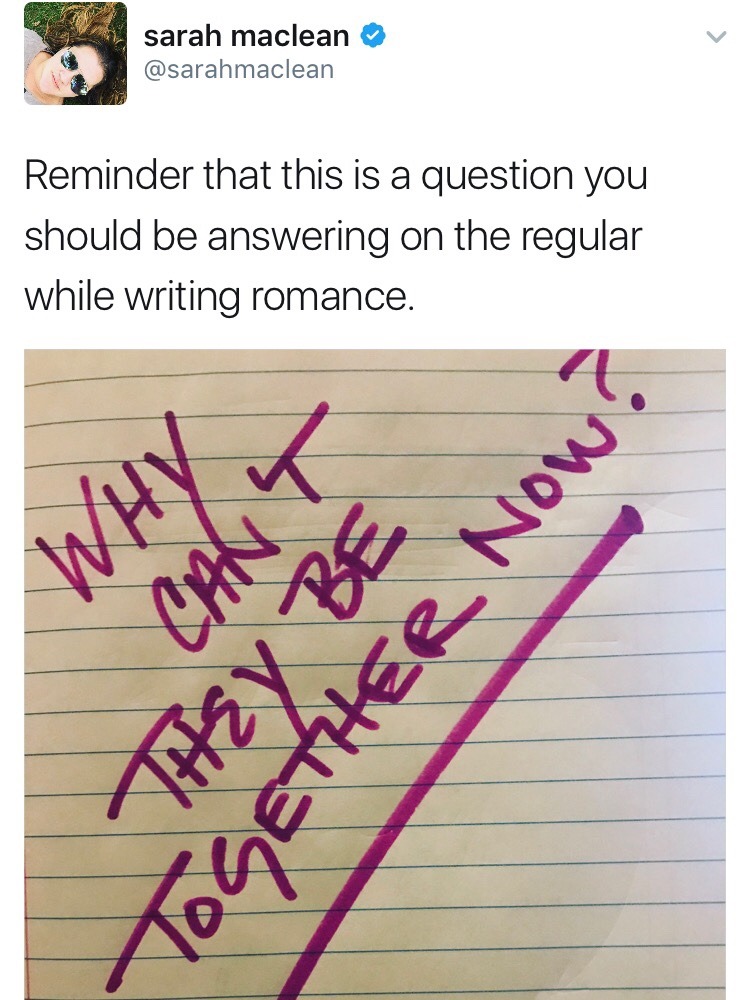
File this under “super obvious yet I always seem to forget it.”

I don’t write romance (I totally respect people who do, though!) but this is also great writing advice in general! What is preventing the protagonist from achieving their goal?

Why can’t these two people be together now?

Why can’t the mystery be solved now?

Why can’t they overthrow the evil overlord now?

If you don’t have a solid answer for these questions, that’s a good indicator that the plot could use some more work.

Also test your answer a little bit. If it’s as thin as they’re just refusing to sit down and have a simple conversation, you might want to re-think how things are going.

As a beta reader/editor, I tend to ask this question a lot: “Why are they doing it this way when there’s a much easier path available?” That’s not to say that they should take the easier path, because that would usually be boring. Instead, the point is that the question needs an answer–either eliminate the easier path or give them a very clear reason for not taking it. (And if I’m asking the question, that reason isn’t as clear as you think it might be.)

I find it very difficult to root for characters who have a sensible option available and just don’t take it. If the only reason is “Because there wouldn’t be a story otherwise,” you haven’t actually found the story yet.

And this is why the Big Misunderstanding as a primary plot device is almost universally disliked.

heywriters:

albatris:

hey. hey. I have a confession

I fuckin LOVE dialogue as a first line. I adore it. whenever I flip open a book and the first line is dialogue I’m like hell YES this is my SHIT

there’s lists of, uh, TOP TEN WAYS YOU SHOULD NEVER START YOUR NOVEL EVER and “opening with dialogue” is always on them

the gist being that it’s bad bc the reader doesn’t care about this character yet so why are they gonna care about this dialogue, right, they don’t have any context for it, you should start with something that gets the reader invested and emotionally pulled in, so on, so forth

(and I’m not here to argue or call bullshit on these lists or anything…… 99% of the time, the reasons listed of why you should Maybe Not Do The Thing are perfectly valid concerns and dangers that should be taken into consideration)

(this post is more a ramble about personal preference with a nice moral at the end)

(and definitely not a TOP TEN REASONS “TOP TEN WAYS YOU SHOULD NEVER START YOUR NOVEL EVER” LISTS ARE LIES AND SLANDER post god could you imagine)

but yeah, for me, dialogue opening lines pull me right the fuck in emotionally. for real. nine times out of ten they’ll yank me in and have me engaged instantaneously. always have, probably always will

(like come on. have y’all never just started eavesdropping right in the middle of some total strangers’ conversation on the bus. especially if it’s somethin weird. it’s so good)

but ANYWAY, the moral is uhhhh

whatever Mortal Writing Sin you wanna commit, there’s probably at least one weirdo out there possibly named logan who digs it

do whatever the fuck you want, honestly

you can write an opening scene that does everything every advice page tells you to do with an opening scene and it can still be shit

you can write an opening scene doing everything every advice page tells you NEVER to do with your opening scene and it can still be fabulous and engaging

if you can pull it off, literally who cares

“if you can pull it off, literally who cares“ is the only real writing rule

Ways To Describe Someone’s Voice

writers-are-writers:

hazzabooween:

  • adenoidal (adj): if someone’s voice is adenoidal, some of the sound seems to come through their nose
  • appealing (adj): an appealing look/voice shows that you want help, approval, or agreement
  • breathy (adj): with loud breathing noises
  • brittle (adj): if you speak in a brittle voice, you sound as if you are about to cry
  • croaky (adj): if someone’s voice sounds croaky, they speak in a low, rough voice that sounds as if they have a sore throat
  • dead (adj): if someone’s eyes or voice are dead, they feel or show no emotion
  • disembodied (adj): a disembodied voice comes from someone who you cannot see
  • flat (adj): spoken in a voice that does not go up and down; this word is often used for describing the speech of people from a particular region
  • fruity (adj): a fruity voice or laugh is deep and strong in a pleasant way
  • grating (adj): a grating voice, laugh, or sound is unpleasant and annoying
  • gravelly (adj): a gravelly voice sounds low and rough
  • gruff (adj): this voice has a rough, low sound
  • guttural (adj): a guttural sound is deep and made at the back of your throat
  • high-pitched (adj): true to its name, a high-pitched voice or sound is very high
  • hoarse (adj): someone who is hoarse, or has a hoarse voice, speaks in a low, rough voice, usually because their throat is sore
  • honeyed (adj): honeyed words or a honeyed voice sound very nice, but you cannot trust the person who is speaking
  • husky (adj): a husky voice is deep and sounds hoarse (as if you have a sore throat), often in an attractive way
  • low (adj): a low voice is quiet and difficult to hear; also used for describing a deep voice that has a long wavelength
  • matter-of-fact (adj): usually used if the person speaking knows what they are talking about (or absolutely think they know what they are talking about)
  • modulated (adj): a modulated voice is controlled and pleasant to listen to
  • monotonous (adj): this kind of voice is boring and unpleasant due to the fact that it does not change in loudness or become higher/lower
  • nasal (adj): someone with a nasal voice sounds as if they are speaking through their nose
  • orotund (adj): an orotund voice is loud and clear
  • penetrating (adj): a penetrating voice is so high or loud that it makes you slightly uncomfortable
  • plummy (adj): a plummy voice or way of speaking is considered to be typical of an English person of a high social class; this word shows that you dislike people who speak like this
  • quietly (adj): in a soft, quiet voice
  • raucous (adj): a raucous voice or noise is loud and sounds rough
  • ringing (adj): a ringing voice is very loud and clear
  • rough (adj): a rough voice is not soft and is unpleasant to listen to
  • shrill (adj): a shrill voice is very loud, high, and unpleasant
  • silvery (adj): this voice is clear, light, and pleasant
  • singsong (adj): if you speak in a singsong voice, your voice rises and falls in a musical way
  • small (adj): a small voice is quiet
  • smoky (adj): a smoky voice is sexually attractive in a slightly mysterious way
  • softly spoken (adj): someone who is softly spoken has a quiet, gentle voice
  • soft-spoken (adj): speaking or said in a quiet, gentle voice
  • sotto voce (adj, adv): in a very quiet voice
  • stentorian (adj): a stentorian voice sounds very loud and severe
  • strangled (adj): a strangled sound is one that someone stops before they finish making it
  • strident (adj): this voice is loud and unpleasant
  • taut (adj): used about something such as a voice that shows someone is nervous or angry
  • thick (adj): if your voice is thick with an emotion, it sounds less clear than usual because of the emotion
  • thickly (adv): with a low voice that comes mostly from your throat
  • thin (adj): a thin voice or sound is high and unpleasant to listen to
  • throaty (adj): a throaty sound is low and seems to come from deep in your throat
  • tight (adj): shows that you are nervous or annoyed
  • toneless (adj): does not express any emotion
  • tremulous (adj): if your voice is tremulous, it is not steady; for example, because you are afraid or excited
  • wheezy (adj): a wheezy noise sounds as if it is made by someone who has difficulty breathing
  • wobbly (adj): if your voice is wobbly, it goes up and down, usually because you are frightened, not confident, or are going to cry
  • booming (adj): very loud and attention-getting
  • quavering (adv): if your voice quavers, it is not steady because you are feeling nervous or afraid
  • a voice like a foghorn: very loud voice
  • in an undertone: using a quiet voice so that someone cannot hear you
  • someone’s dulcet tones: the sound of someone’s voice as they speak

A Nonny asked for how to describe voices and I found this so here you go!

anexperimentallife:

bookcharactersthough:

danielle-writes:

Some advice for when you’re writing and find yourself stuck in the middle of a scene:

  • kill someone
  • ask this question: “What could go wrong?” and write exactly how it goes wrong
  • switch the POV from your current character to another – a minor character, the antagonist, anyone
  • stop writing whatever scene you’re struggling with and skip to the next one you want to write
  • write the ending
  • write a sex scene
  • use a scene prompt
  • use sentence starters
  • read someone else’s writing

Never delete. Never read what you’ve already written. Pass Go, collect your $200, and keep going.

This is the literal best writing advice I have ever read. Period.

Special note: “Kill someone” means kill someone in the story. Please do not kill random real life passers by every time you hit a block. My lawyer says misunderstanding writing advice is not an acceptable defense. See you all in 25 to 50 years.