those posts criticizing common writing patterns in fanfiction are so fucking harmful and they ruined me
so like yknow what??? People tell you to avoid “smirk” and “chuckle” as descriptors because no one does those things (???) but then when I need to use those words I have a ten minute crisis about how I’m a shitty writer. So heres my unwarranted writing advice: If you want your characters to smirk and chuckle fucking let them and don’t let anyone tell you that no one smirks or chuckles because I do both on a daily basis whenever I tell a shitty pun, bye
So there was a list going around tumblr for a while that made it to my dash of literary journals that accept open submissions (and will pay!), but upon inspection about half of them were closed indefinitely, and I found quite a few other places that looked interesting through further research, so I wanted to post my own list.
I tried to focus on things that paid professional grade (at least 6 cents per word), were friendly to speculative fiction, and specifically encouraged diversity and writing about marginalized groups.
(Please note that as of right now I have never submitted or been published with any of these, so if anyone has experience with them, good or bad, please feel free to message or reblog this with your experiences.)
Speculative Fiction
Strange Horizons— Speculative fiction (broadly defined) with an emphasis on diversity, unusual styles, and stories that address politics in nuanced ways. 8c per word. Up to 10,000 words, under 5,000 preferred. Responds within 40 days. LGBT+ positive.
Asimov’s Science Fiction— Primarily sci-fi but accepts fantasy and surreal fiction, but no high fantasy/sword and sorcery. Prefers writing that is character driven. 8-10c per word. 1,000-20,000 words. Responds in about five weeks.
Evil Girlfriend Media — Horror and urban fantasy centered on female empowerment and defying gender stereotypes. $100 flat payment. 4,000-7,000 words. No response times given. LGBT+ friendly.
Beneath Ceaseless Skies — Fantasy with a focus on secondary worlds and characters. 6c per word. Up to 10,000 words. Average response time 2-4 weeks.
Fantastic Stories— Speculative fiction with an emphasis on diversity and literary style. 15c per word. Up to 3,000 words. Responds within two weeks. LGBT+ positive.
Fiction Vortex— Serialized fantasy and speculative fiction. $300 for featured stories, $50 otherwise. 3,500 words or less. No response times given.
Shimmer— Speculative fiction with an emphasis on diversity, strong plots, vivid characters, and beautiful writing. 5c per word. 7,500 words or less (will consider longer words with query letter). Usually responds within two weeks. LGBT+ positive.
Clarkesworld Magazine— Sci-fi, fantasy, and other speculative fiction. 10c per word up to 5,000 words, 8c per word after. 1,000-16,000 words. Responds within days usually, gives a tracking number.
Apex Magazine— Speculative fiction of all kinds. 6c per word, +1c per word for podcast stories. Up to 7,500 words, all submissions over will be auto-rejected. Responds within 30 days.
Heliotrope Magazine— Speculative fiction of all kinds. 10c per word. Up to 5,000 words. Responds within 30 days.
Lightspeed Magazine— Speculative fiction of all kinds, with creativity and originality in terms of style and format encouraged. 8c per word. 1,500-10,000 words, under 5,000 preferred. LGBT+ positive. Submissions temporarily closed for their main magazine but is accepting for their People of Color Destroy Science Fiction special.
General Fiction
The Sun Magazine— General fiction, likes personal writing or writing of a cultural/political significance. $300-$1500 flat payment and a one year subscription to the magazine for fiction (also accepts essays and poetry). No minimum or maximum lengths but over 7,000 words discouraged. Responds in 3-6 months. Physical submissions only.
One Story— Any and all varieties of fiction, “unique and interesting” stories encouraged. $500 payment plus 25 contributor copies. 3,000-8,000 words. Usually responds in 2-3 months.
Camera Obscura— General fiction. $1000 for featured story, $50 for “Bridge the Gap” award, no payment for other contributors. 250-8,000 words. Response time vary, running just over two months as of now.
Flash Fiction
Daily Science Fiction— Speculative flash fiction (including sci-fi, fantasy, slipstream, etc.). 8c per word. Up to 1,500 words, but shorter stories given priority. Response times not listed.
Vestral Review — General flash fiction. 3-10c per word depending on length to a max of $25. Up to 500 words. Response within four months.
Flash Fiction Online— General flash fiction. $60 flat payment. 500-1,000 words. Response times not listed.
Novels/Novella
Riptide Publishing — Any LGBTQ manuscripts between 15,000 and 150,000 words. Currently especially interested in lesbian romances, trans stories, asexual/aromantic stories, romances with a happy ending, and genre fiction such as urban fantasy. Also has a YA branch. LGBT+ positive.
Crimson Romance — Romance stories of all kinds, currently seeking LGBT+ stories with a focus on emotional connections and relationships, especially m/m romance. Novel (55,000-90,000 words) or novella (20,000-50,000 words) length. LGBT+ positive.
Kindle Direct Publishing
Kindle Direct Publishing— Allows you to set your own prices, create your own cover art, and make royalties off of each sell. Any and all genres are welcome and if you’re prolific and smart about how you’re publishing you can make pretty good money.
Leveraged an inventory of established fictional character and setting elements to generate a disruptive custom-curated narrative entertainment asset.
I worked in HR, handling applications and interviews, and if someone turned in that string of techno babble nonsense, I would have rejected them out of hand.
A resume doesn’t need to sound fancy or overly technical, it needs to tell us why we should hire you.
“Independent novelist/writer” is more than sufficient here. If you want to express the skills that fan fiction taught you, something like, “creative writing, editing, and publication,” will get you a lot further than… Whatever that just was.
A resume should be tailored to the position, if you can afford the time and energy for that. But if not, then just think about what writing got fandom taught you. How to respond to criticism, how to present a professional pubic face, how to correct punished mistakes, creative thinking, project planning, persuasion via emotional leverage, html formatting, office suite fluency.
There are a lot of actual, marketable skills that go into fan fiction.
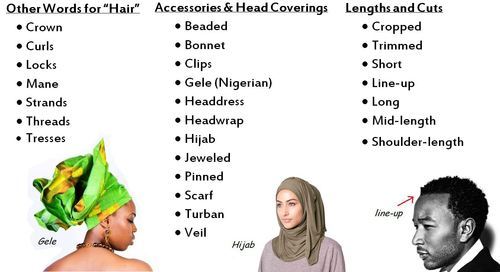
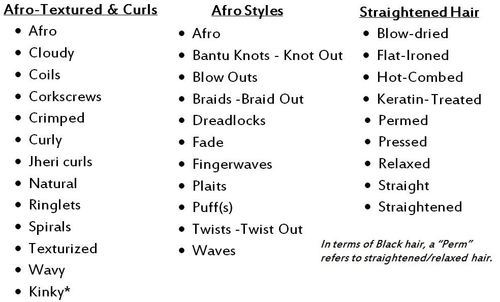
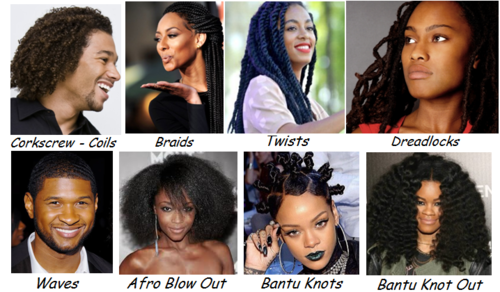
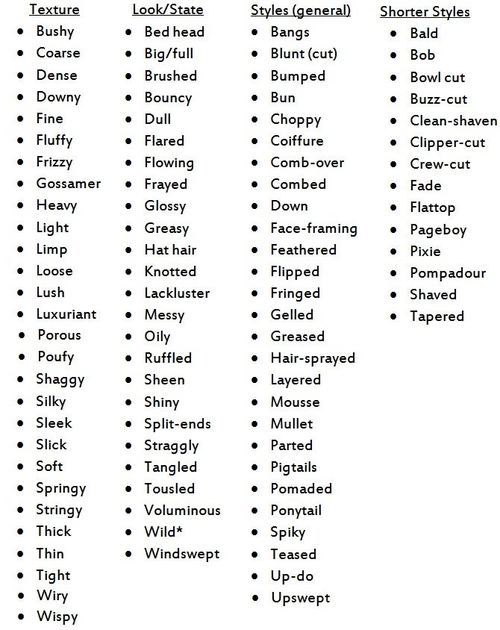
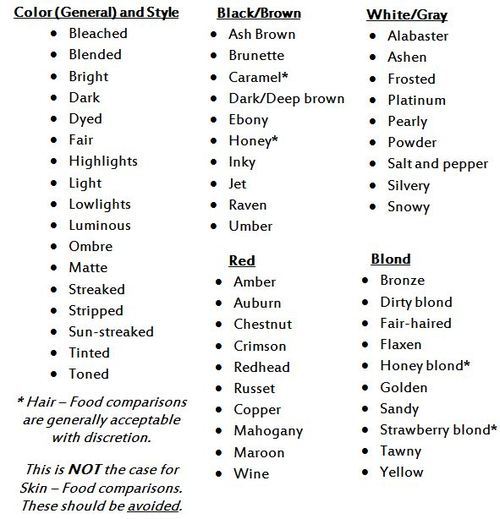
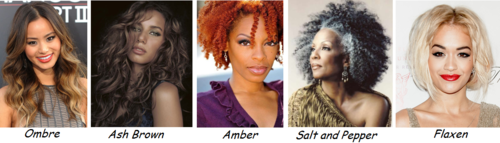
This began as a guide to describing Afro/curly hair but of course, I got carried away. From look and texture of hair, colors and various styles, this guide serves as a thesaurus of sorts for hair, as well as pointers for use in your writing.
Culturally Significant Hair Coverings:
Know the meaning behind head wear and why it’s worn, when and by whom, such as a Native Nation’s headdress, before bestowing a character with it.
Appropriative Hairstyles: Keep in mind that Afro styles should be kept to those in the African Diaspora, such as dreadlocks, cornrows + certain and many braided styles.
Tread carefully describing Afro hair as “wild” “unkempt” “untamed” or any words implying it’s unclean or requires controlling.
“Nappy” and “wooly” are generally words to stay away from, the first having heavy negative connotations for many and the latter, though used in the Holy Bible, is generally not acceptable anymore and comes off as dehumanizing due to Animal connotations.
There are mixed feelings on calling Black hair “kinky.” I’m personally not opposed to the word initself and usage depends on the person’s race (I’m more comfortable with a Black person using it vs. a Non-Black person) as well as their tone and context (if it’s used in a neutral or positive tone vs. negatively/with disdain). Get feedback on your usage, or simply forgo it.
Combination Words: Try combing words to illustrate look of hair. A character with springy coils that dance across her shoulders with every movement, the man with thick silvery hair slicked back into a ponytail…
Mind Perspective: Depending on POV, a character might not know exactly what cornrows or a coiffure style is, at least in name, and it might make more sense if they described the hairdo instead. More defining terms might come from a more knowing source or the wearer themselves. One book I read described a girl’s afro puff as “thick hair pulled up into a cute, curly, poufy thing on top of her head and tied with a yellow ribbon.”
POC & Hair Colors: People of Color’s hair comes in all shades and textures. There are Black people with naturally blond and loosely-textured to straight hair, East Asian people with red hair, and so on. Keep that in mind when coding characters if you tend to rely on hair color alone to denote a character is white vs. a Person of Color.
Related Tropes: There are tropes and discussion related to People of Color, colored hair, and light-colored hair and features.
my level of fanfiction productivity ranges from “typing 20,000 words over the span of 3 days” or “opening a document and staring at it for a year without typing anything at all.” there is no middle ground.
When you only want to write certain parts of your story, but in order for those parts to make sense and have any impact you need to write other parts connecting them and you just don’t… wanna…
I literally only have one rule in my writing and it is this:
No matter what I put my characters through, they make it. They get to make it to the end of the story and have everything work out and be ok.
Because that’s the story I need. So it’s the kind I write.
If you want a piece of writing advice: write a story that is what you needed to hear at whatever age your target demographic is. I can guarantee you there’ll be someone out there who needs to hear it as much as you did. And maybe you’ll help them the same way someone else’s story did for you.
For some reason, this hit home and I never realized it that I did this for my stories too



 Crowfanity's Tumblr